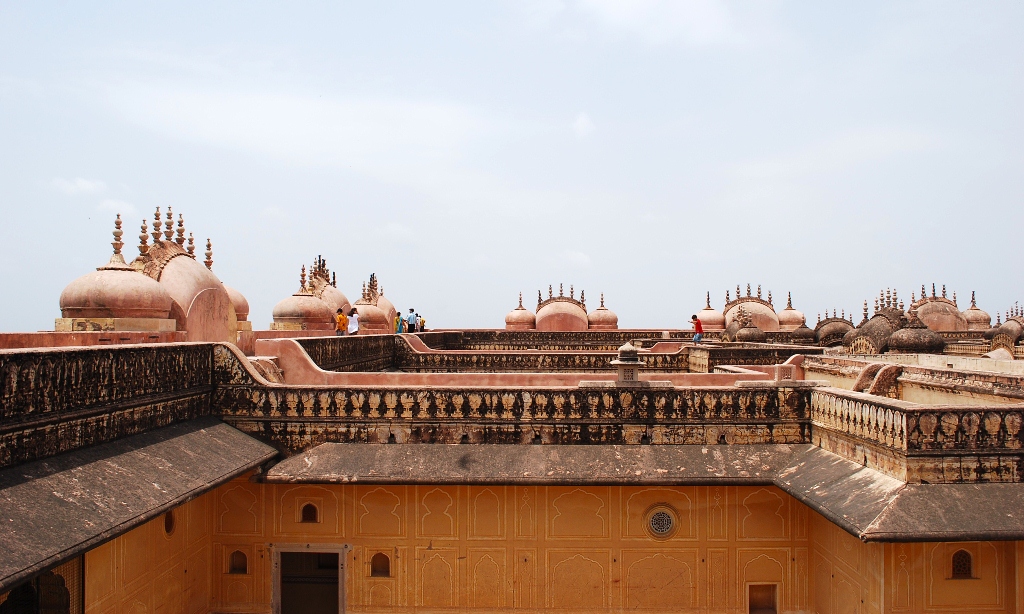
Jaipur is the dazzling capital of Rajasthan and, for most travelers, the grand finale of India's Golden Triangle. Founded in 1727 by the astronomer-king Maharaja Sawai Jai Singh II, it was one of India's earliest planned cities — laid out on a precise grid according to the principles of the ancient architectural treatise Vastu Shastra, with broad avenues, ordered market squares and a fortified old city. In 2019 that walled old city was inscribed as a UNESCO World Heritage Site.
Its famous nickname dates to 1876, when the entire old town was painted a warm terracotta pink — the traditional colour of hospitality — to welcome the Prince of Wales. The hue stuck, and to this day the rose-tinted bazaars of the walled city glow at sunset beneath the watchful forts on the surrounding Aravalli hills. Within these walls you'll find the honeycombed Hawa Mahal, the regal City Palace still home to Jaipur's royal family, and the open-air observatory of Jantar Mantar.
Yet Jaipur is far more than its monuments. It is Rajasthan's beating cultural and commercial heart — a place to shop for hand-block-printed textiles, polished gemstones, lac bangles and the city's signature blue pottery; to feast on rich Rajasthani thalis and ghewar sweets; and to ride a jeep up to the magnificent Amber Fort. Two to three unhurried days let you weave between palaces and bazaars without rushing, with the option to push deeper into Rajasthan's deserts and lakes from here.